
主页 / 公司 / 博文 / Beyond the Clinic: A Blueprint for Developing Reliable, Edge AI-Enabled Medical Devices

Beyond the Clinic: A Blueprint for Developing Reliable, Edge AI-Enabled Medical Devices

In a quiet farmhouse in rural Utah, hundreds of miles from the nearest city, a pregnant mother wakes up and waits for a kick that doesn’t come. In this part of the country—one of the many "medical deserts" where 30% of counties lack a single gynecologist—the nearest hospital is a 500-mile journey. Usually, this moment of silence leads to a desperate phone call to an HMO where a nurse asks the mother a long series of questions, such as what she ate or drank, followed by the inevitable long and tense drive to the emergency room.

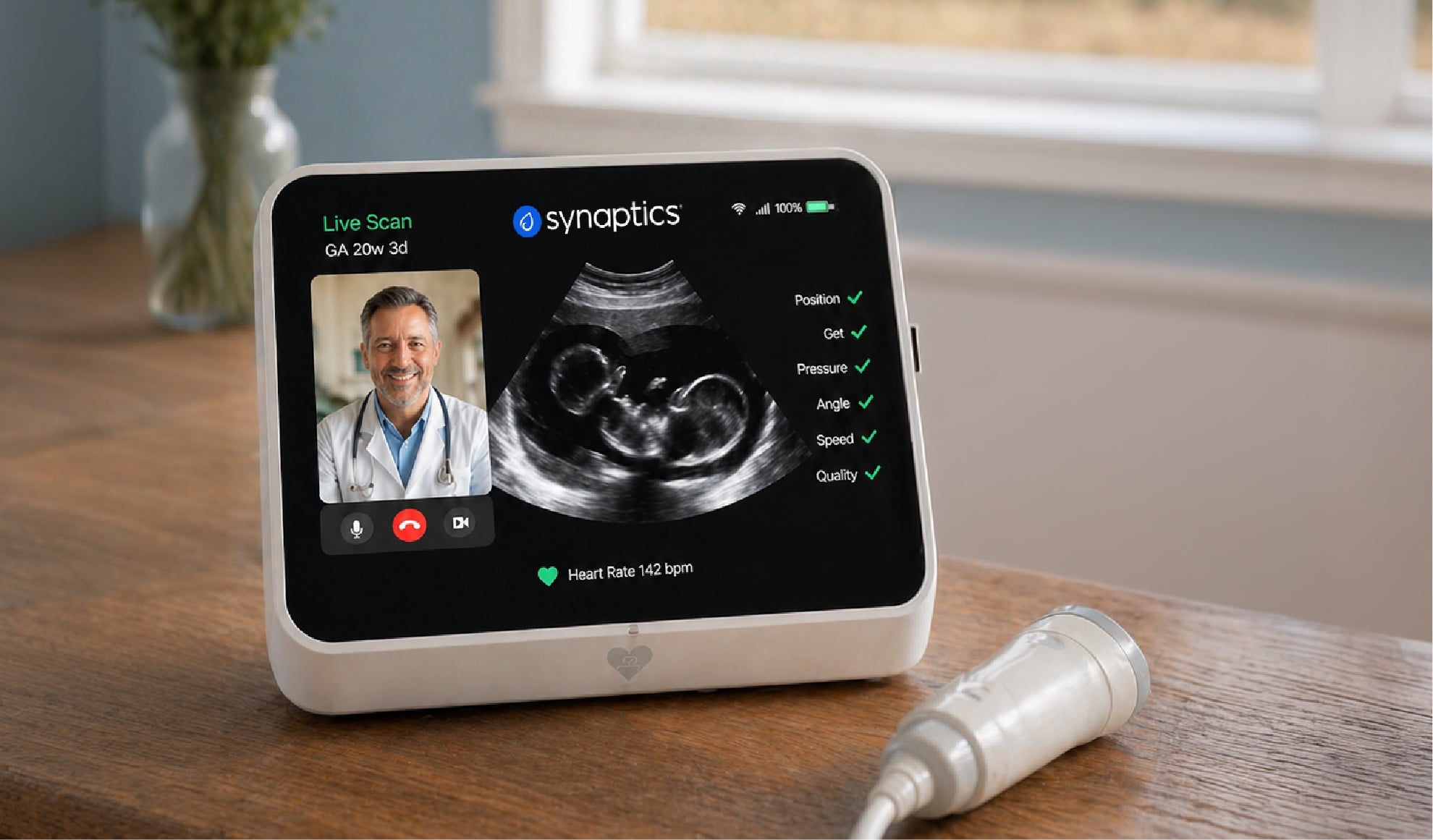
But this time, the mother reaches for a handheld cradle instead of her car key. She applies the gel and begins to slide the probe across her belly, guided not by a person in the room, but by Edge AI embedded directly into the device.

The device speaks to her. When she moves too quickly in her panic, an audible alert tells her to slow down. When she accidentally positions the probe over her own chest, the system recognizes the latency-free data and immediately warns her she is capturing her own heartbeat, not the baby’s. It forces her to be precise, telling her to "add more gel" or "change location" until the image is clinically usable.

Within three minutes, the scan is complete. Because the device processes eight to ten critical parameters locally and almost in real-time, it doesn't need to wait for a cloud connection to identify a crisis. The data is transmitted almost instantly to a physician who sees the danger from afar, and sends help immediately.  

Life at the Edge, Not on the Edge 

The landscape of healthcare is undergoing a fundamental transformation, shifting from the sterile, controlled environment of the clinic directly into the patient's home. This shift is particularly critical in areas that lack essential specialists like gynecologists and sonographers. In these regions, a patient may be 500 miles away from the nearest hospital, making traditional, frequent diagnostic imaging nearly impossible.  

To bridge this gap, companies like Pulsenmore are pioneering a new paradigm where the patient becomes the operator of complex medical hardware. But moving a sophisticated tool like an ultrasound probe from the hands of a trained professional to a layperson introduces significant risks to clinical reliability. The solution to maintaining medical quality at scale lies in the integration of Edge AI—intelligence embedded directly into the device to provide real-time guidance and ensure every scan is clinically usable. 

The Clinical Necessity of Edge AI 

When designing a medical device for home use, the primary hurdle is ensuring that the data captured is as accurate as a scan performed in a hospital. Relying on cloud-based processing for this task presents an obstacle: latency. In a traditional cloud architecture, data is transmitted to a remote server, processed, and then sent back to the user, a loop that takes several seconds. In the context of medical imaging, where a patient is physically moving a probe across their body, those seconds are an eternity.

Processing data at the Edge—directly on the devices hardware—allows for almost real time feedback. This immediacy is vital for safety and effectiveness. For example, if a pregnant patient accidentally moves the probe from her abdomen to her chest, an Edge AI-enabled device can immediately alert her that she is scanning the wrong location. Without this instant intervention, a patient might mistake her own heartbeat for the baby’s, leading to a false sense of security or incorrect clinical data.  

Also, high-resolution ultrasound devices produce a massive volume of data, roughly 25 images per second, which is prohibitively expensive and slow to process entirely in the cloud. By utilizing an AI-native embedded compute platform like Synaptics Astra™, ultrasound probes process critical parameters locally and nearly instantaneously, ensuring the remote physician receives high-quality, relevant data. 

Engineering the Intelligent Handshake with Real-Time User Guidance 

The core challenge of a patient-operated device is the inherent subjectivity of the procedure. Ultrasound quality depends heavily on the "hand that holds the skin," and variables such as a patient's BMI, gestation week, or how firmly they push the probe drastically alter the results. To create a reliable device, engineers must build an intelligent handshake between the hardware and the user.

This is achieved through specific AI-driven guidance features that monitor the user's movements and environmental factors. Through the mobile application, Edge AI provides audible and visual alerts to standardize the scanning process. If a patient moves the probe too quickly, AI guides them audibly to slow down. If there is insufficient acoustic coupling—meaning not enough gel has been applied to the belly—the device issues an alert to add more gel. These interventions ensure that even a first-time user produces a standardized, relatively reliable medical image after just a short learning curve. This real-time quality control effectively reduces miss-cases and errors that sometimes happen even in clinics (to the tired sonographer working a late shift, for example). 

The Hardware Balancing Act 

Developing reliable Edge AI for medical applications requires a delicate engineering balance. Dr. Elazar Sonnenschein, CEO of Pulsenmore, describes this challenge as a blanket with four corners: developers must constantly balance (1) algorithm complexity, (2) memory requirements, (3) processing horsepower, and (4) price.

Because home medical devices are often intended for a single pregnancy or a specific treatment window, they must be cost-effective. Unlike hospital equipment designed to last for years, a home ultrasound cradle may only be used for six months before being discarded. This necessitates using silicon that provides high performance without the massive price tag of high-end server chips.  

The collaboration between Pulsenmore and Synaptics focuses on finding this sweet spot, utilizing silicon that is natively secure and power-efficient, while still having enough horsepower to run complex AI models. The goal is to make devices affordable for home use without compromising performance, reliability, security, or usability.  

The team at Synaptics collaborated to find the right balance across the Astra portfolio of embedded processors for this exact use case, with input from local reps, engineering, and sales to match performance, regulatory needs, and price point. This ensured that devices were affordable without cutting corners on the performance or reliability of medical data.  

Setting the High Bar with Safety and Regulatory Benchmarks 

For a medical-grade Edge AI device to be truly reliable, it must meet rigorous clinical and regulatory standards. This goes beyond mere technical functionality. It requires proving that the AI is consistent, unbiased, and accurate. 

  • Consistency: The algorithm must not generate different answers for different patients in identical clinical situations.
  • Low Bias: The system must be validated across a diverse global population to ensure it works reliably regardless of the user's background or body type.
  • Zero Hallucination: In a medical context, the AI must never generate results that aren't there. For example, it must never show a heartbeat in case there is none or "see" twins when there is only one fetus. 

Building this level of trust requires training AI models on massive, proprietary datasets. Pulsenmore’s models are trained on hundreds of millions of images from hundreds of thousands of scans. This large-scale data allows the AI to recognize clinical edge cases and abnormalities, such as a heart rate falling below 100 beats per minute, or rising above 160, which signals a fetus may be in distress. By demonstrating this reliability through extensive clinical data and testing, developers meet the high bar required for FDA authorization and international medical standards. 

One Goal: Saving Families Through Technology 

Ultimately, the technical complexity of Edge AI serves a profound human purpose. The goal of a reliable, intelligent medical device is to empower patients and save lives. By enabling asynchronous sessions—where a patient scans at home and the clip is sent to a doctor to review from anywhere in the world, healthcare becomes accessible in even the most remote areas.

The impact of this technology is not theoretical. Dr. Sonnenschein recalls a case in Israel where an expectant mother used the home ultrasound device. The AI-guided scan revealed that the umbilical cord was wrapped around the baby's neck. Because of the immediate availability of that data, an ambulance was dispatched, and the mother underwent a successful C-section within an hour, resulting in a healthy baby girl.  

“This,” says Dr. Sonnenschein, “is the ultimate benchmark for a reliable medical device. It moves beyond being a piece of hardware and becomes a life-saving tool that protects families.” By combining high-performance Edge AI with deep clinical expertise, the industry is creating a future where desert care is a thing of the past, and quality medical imaging is available to everyone, everywhere.

No one should have to choose between waiting in fear and driving hundreds of miles for answers. The technology to change that is here today. Now the challenge is to build it responsibly, scale it reliably, and put it in the hands of everyone who needs it. The future of healthcare belongs at the Edge.  

Written in Partnership with

Dr. Elazar Sonnenschein

Elazar Sonnenschein, Ph.D., is an entrepreneur and executive with extensive experience in the global medical device industry. He is the founder and CEO of Pulsenmore Ltd., where he led the development and commercialization of an innovative home ultrasound solution, achieving FDA De Novo clearance and driving adoption across international healthcare markets through strategic partnerships, including with GE Healthcare. Prior to Pulsenmore, Elazar served as CEO and COO of Medigus Ltd. Earlier in his career, Elazar held a senior leadership role at Green Software House. He holds a Ph.D., M.Sc., and B.Sc. in engineering from Ben-Gurion University of the Negev and is the author of numerous publications and patents in acoustics and medical imaging.

Neeta Shenoy

Neeta 于 2024 年 4 月加入新突思(Synaptics),现任企业市场营销副总裁,凭借在科技行业推动高影响力营销战略的出色履历,持续为公司品牌与业务发展注入动能。作为一位经验丰富的全球市场营销高管,Neeta 在 B2B 技术营销领域拥有深厚的专业背景。她曾领导多个核心营销职能,包括需求生成、品牌战略以及以产品驱动的增长等方面,具备广泛的实战经验。 Neeta 拥有新闻学学士学位、传播学硕士学位,并获得西北大学凯洛格管理学院(Kellogg School of Management)的高管管理认证。

Read more by Neeta Shenoy
AI 边缘计算
接收最新消息