

Engineering teams are feeling the pressure of rapid industrial automation. Devices need to support more data, more sensing and more real-time control. The wireless foundation underneath everything still struggles with latency spikes, radio frequency (RF) noise and unpredictable behavior in harsh environments. This is a critical challenge.
Production lines depend on precise timing. Robotics systems require coordination that can’t afford jitter, and every year, device density continues to increase while your operational expectations rise with it.
Previous Wi-Fi generations made progress, but they were not built around the determinism that modern industrial systems require. They fall short of meeting current demands. Below, we’ll explore how Wi-Fi 7 is powering the next wave of industrial Internet of Things (IIoT) innovation, and how its capabilities translate into practical advantages for automation, robotics and real-time control.
The Core Features of Wi-Fi 7 for the Manufacturing Industry
To truly understand the impact of Wi-Fi 7, it’s essential to look beyond just faster speeds. This new standard introduces several features. For industrial teams, three stand out as especially transformative.
1. Multi-Link Operation (MLO) for Reliable Industrial IoT Connectivity
MLO enables devices to communicate simultaneously over multiple bands, including 2.4 gigahertz (GHz), 5 GHz and 6 GHz. This directly improves reliability in challenging industrial environments.
The following are a few key ways in which MLO supports industrial wireless performance:
- Redundant paths for traffic: If one band experiences interference, data continues flowing on another without interruption.
- Low latency: By selecting the best available link, MLO minimizes latency and inconsistent timing. This ensures more-consistent timing during real-time control or synchronized motion.
- Improved performance under load: Traffic can be distributed across multiple bands, reducing congestion and delays.
2. 320 MHz Channels for High-Bandwidth Data in Industrial Systems
Wi-Fi 7 expands channel widths up to 320 megahertz (MHz), which is double the width offered by Wi-Fi 6. This wider channel creates more room for industrial devices that need to push large amounts of data quickly.
The following examples illustrate how 320 MHz channels support heavy workloads:
- Machine vision and inspection: High-resolution image streams from cameras used for quality control or defect detection.
- Edge AI and analytics: Real-time sensor fusion, anomaly detection and predictive maintenance models that depend on frequent data updates.
- Digital twins and simulation: Continuous data feeds from equipment and sensors into digital twin platforms or supervisory control systems.
3. 4K QAM for Efficient Spectrum Use in Crowded IIoT Environments
Wi-Fi 7 introduces 4K Quadrature Amplitude Modulation (QAM), which increases the amount of data encoded in each transmission. This improves throughput and spectral efficiency, especially when the network is busy.
The following are some practical benefits of 4K QAM for industrial IoT systems:
- Higher data rates in a given channel: Devices complete transmissions more quickly, freeing airtime for other devices.
- Better use of limited spectrum: In environments with numerous devices and limited channels, improved efficiency helps maintain performance as device density increases.
- Opportunities for power savings: When transmissions complete more quickly, some devices return to lower power states sooner, which is particularly essential for battery-powered sensors.
How Wi-Fi 7 Is Powering Industrial IoT Innovation
The true potential of Wi-Fi 7 becomes clear when its advanced features are applied to real-world industrial problems.
Achieving Deterministic, Low-Latency Performance for Real-Time Control
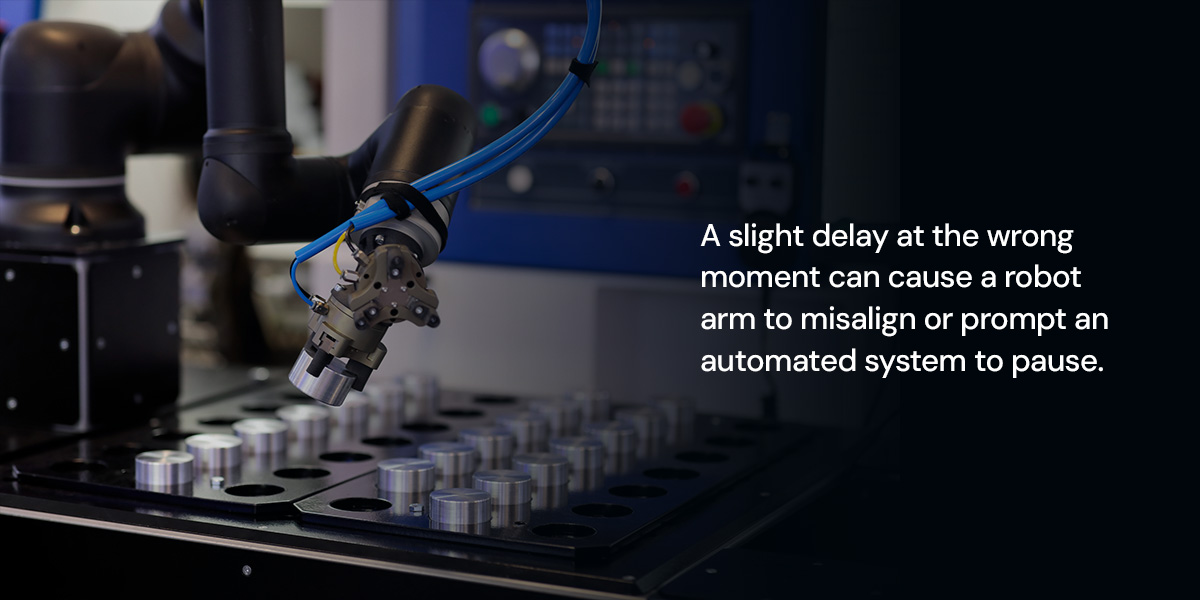
In many industrial environments, low latency only matters if it is consistent. A slight delay at the wrong moment can cause a robot arm to misalign or prompt an automated system to pause.
Wi-Fi 7 supports more-predictable performance, since MLO allows time-sensitive traffic to align with the most stable and low-latency path in real time, instead of being locked to a single band that might become busy. In addition, more-efficient handling of simultaneous access demands reduces jitter caused by variable backoff and retries, resulting in a more stable and predictable network.
Ensuring Robustness in Harsh RF and Physical Environments
Industrial spaces are filled with metal beams, shelving, enclosures and machinery. Slow-moving equipment, such as forklifts and overhead cranes, often blocks paths. Motors and heavy equipment produce electromagnetic noise that disrupts signals. Wi-Fi 7 is better equipped to manage this type of environment.
In these harsh environments, MLO provides multiple bands to work with, so devices are not locked into a band that suffers from recurring interference. Additionally, with improved scheduling and resource allocation, Wi-Fi 7 manages heavy traffic more effectively, even when some sections of the spectrum experience intermittent noise.
Supporting High-Density Industrial IoT Connectivity
The expansion of industrial IoT is creating unprecedented device density. For example, a single facility may host thousands of sensors, dozens of mobile robots, operator tablets, machine controllers and safety systems, all sharing the same wireless infrastructure.
Wi-Fi 7 addresses this density through its higher overall capacity since wider channels and 4K quadrature amplitude modulation increase the amount of data that can be moved in a given period. The expanded multi-user, multiple-input, multiple-output (MU-MIMO) capabilities also enable more devices to transmit and receive data simultaneously, thereby minimizing delays.
Wi-Fi 7 Industrial Applications in Automation and Robotics
The new capabilities of Wi-Fi 7 support a more ambitious approach to automation. Engineering teams can design systems that rely on wireless connectivity without worrying that mobility or precision will be compromised.
Advanced Automation and Collaborative Robotics
Automation is shifting toward more-mobile, flexible and collaborative systems. Collaborative robots (Cobots) work alongside people, automated guided vehicles (AGVs) navigate dynamic routes and production lines change configurations based on real-time demand.
The following are examples of how Wi-Fi 7 supports advanced automation and robotics:
- Collaborative robotics: Stable, low-latency links support safe, coordinated movements when robots work alongside people.
- Mobile robotics and AGVs: Reliable connectivity across large facilities helps navigation, fleet coordination and dynamic task assignment function smoothly.
- Distributed control networks: Controllers and sensors participate in wireless control architectures, enabling more flexible production layouts.
Real-Time Asset Tracking and Management Over Wi-Fi 7
Asset tracking and real-time location services (RTLS) have become essential tools for managing inventory, tools and mobile equipment. Wi-Fi 7 improves these systems by increasing refresh rates and reliability while scaling to more tracked items.
Wi-Fi 7 unlocks significant improvements in asset tracking and management. With higher throughput and better scheduling capabilities, tags and tracked devices now report their positions without overloading the network. Additionally, in locations where numerous assets and personnel are concentrated, Wi-Fi 7’s density handling helps maintain smooth RTLS performance.
Wireless High-Bandwidth Machine Vision With Wi-Fi 7
Machine vision and imaging are central to modern industrial quality control, inspection and predictive maintenance. Historically, many systems relied on Ethernet because previous Wi-Fi generations were unable to reliably handle high-resolution video streams.
Wi-Fi 7 empowers industrial machine vision through several key advancements. The availability of 320 MHz channels supports high data rates for 4K and even higher-resolution camera streams. Additionally, 4K QAM allows cameras to transmit detailed imagery without excessive compression.
Build Your Next IIoT Device With Synaptics
Selecting the right wireless foundation is essential for any next-generation industrial device. Wi-Fi 7 introduces powerful capabilities, but those benefits can only be realized through solutions that implement the standard with industrial-grade reliability.
Synaptics’ Connectivity Wi-Fi 7 solutions are designed to address these demands and provide the industrial IoT connectivity foundation needed for the next generation of automation, robotics, sensing and real-time control devices.
If you’re planning your next IIoT platform or evaluating how to upgrade an existing product line, this is an ideal moment to align your wireless strategy with Wi-Fi 7. Contact us today to explore how purpose-built Wi-Fi 7 silicon can support your applications.