
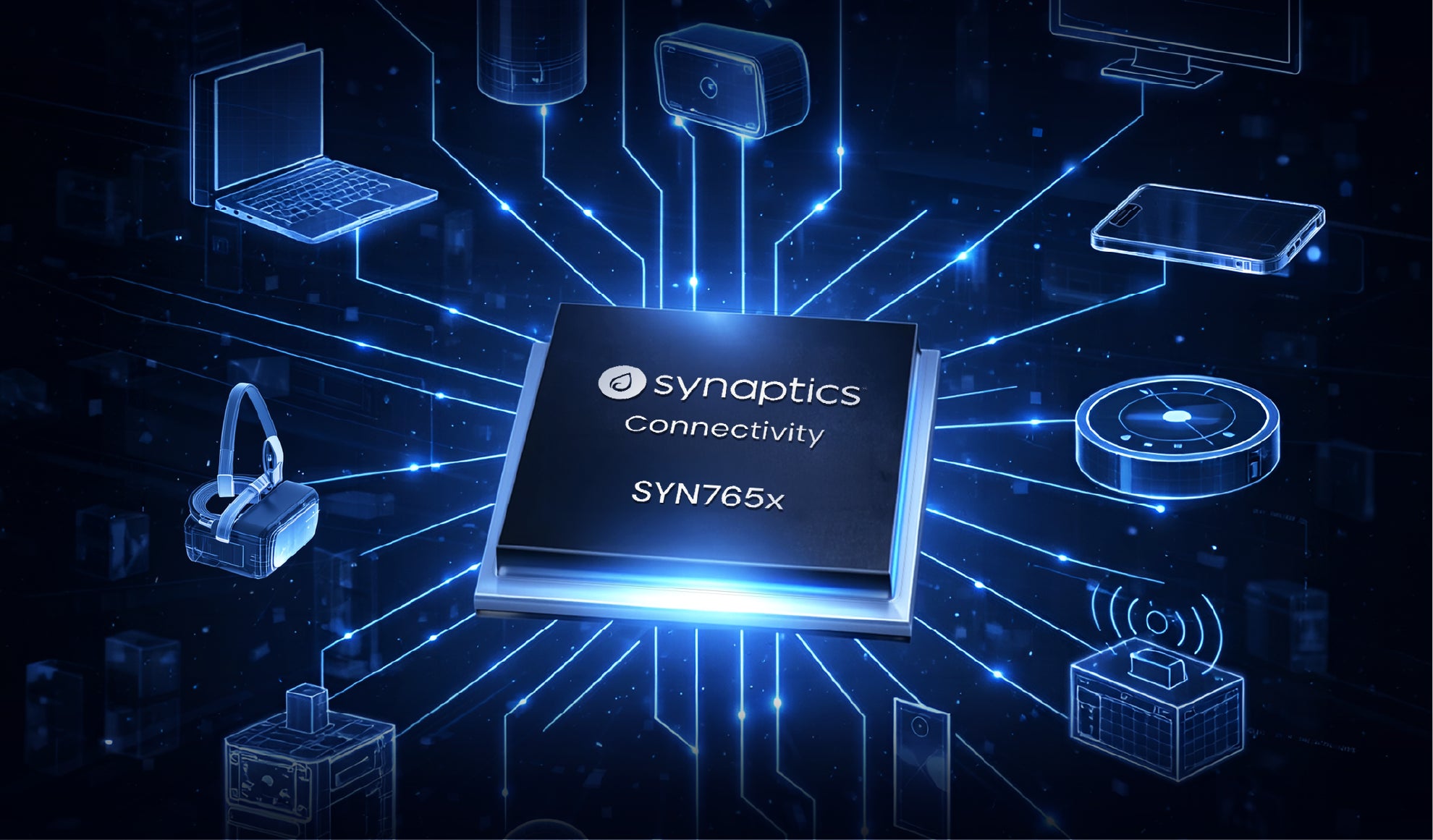
Wireless connectivity technologies keep evolving, so it is more important than ever to use the latest Wi-Fi protocol when choosing a wireless SoC for IoT devices. It takes time for a new Wi-Fi protocol to expand beyond the initial targeted products of Wi-Fi access points, smartphones, and PCs and into the broader IoT space, and we are at that point with Wi-Fi 7 now. An intelligent IoT device must support three basic functions: process, connect, and sense. It must be able to process information, connect to other devices or to the Internet, and collect data from the world around it through various sensors.
Process
The vast majority of IoT devices use an MCU that is powerful enough for the application and yet runs at low power consumption. Recently, MCUs have also added NPUs to process AI inference workloads with very low power consumption. This combination of an MCU and NPU is the modern minimum requirement for any IoT device that performs any type of on-device AI. On-device AI is used for a combination of reasons spanning privacy, security, reliability, and availability. It can include hybrid AI, where the device also leverages more powerful cloud AI services when appropriate and where privacy and security are not a concern.
Connect
IoT devices, by definition, have some form of connectivity. Intelligent IoT devices will need Wi-Fi. In the past, Wi-Fi or Bluetooth would be used to update firmware on the device or to control it via a smartphone. More importantly, small AI inference models are being included to add a voice interface and response that can use natural and varied language and increase the functionality of the device. It is the shift to AI capabilities over the Internet that changes the approach to choosing a Wi-Fi protocol. In the past, there had been a focus on using the lowest cost option that would work. For many devices that became Wi-Fi 4 (802.11n), even as some devices shifted to Wi-Fi 5 (802.11ac). Since Wi-Fi 5 was dual-band and more complex, it cost more. Additionally, Wi-Fi 5 drew more power. This led many device makers to continue to use Wi-Fi 4. Wi-Fi 6 shifted from OFDM to OFDMA, reduced power consumption, and introduced new features. Wi-Fi 6E added the ability to use the 6 GHz band. Wi-Fi 7 brought many newer features, including multi-link operation (MLO), which greatly increased reliability by enabling operation across multiple bands. Moving to these newer protocols does not necessarily mean a significantly more expensive option. Wireless MCUs are more likely to be 1X1 rather than 2X2 MIMO, and some would be dual-band rather than tri-band. Therefore, devices can be designed with the latest Wi-Fi protocol while keeping power consumption and cost lower.
Using the latest Wi-Fi protocol matters for many consumer devices, and especially enterprise and industrial devices. As they use cloud AI services, there will be an expectation that the devices continue to work as expected. This means they must connect well even at longer ranges and with many other devices on the same access point. They must also connect with reliably low latency. Most of all, they cannot be in a position to become obsolete long before their time. Some consumer devices may be used for 10 years or even longer. In the industrial space, this life cycle might be 10, 15, or even over 20 years. That is a long time in terms of the continued evolution of Wi-Fi. The Wi-Fi 6 protocol is now over six years old. As the life span of a device using Wi-Fi 6 progresses, its connectivity will always be an additional six years out of date. This issue is far worse with Wi-Fi 4 since that protocol is over a decade and a half old. Using older protocols could annoy consumers if they run into problems, but it is a nonstarter in the industrial space.
Sense
After covering compute and connectivity, sensing completes the trifecta. Sensors used can be one or more of the following: microphone, camera, multiple cameras of different types, vibration, light, chemical, temperature, and many more. Depending on the type of sensor needed and the application, Wi-Fi could provide the added benefit of being a sensor with no additional cost. Wi-Fi can be used to sense proximity and motion, for example, to know when to turn a screen on or perform some other action.
Using Wi-Fi 7 is Critical for IoT Devices with Long Life Spans
Wireless connectivity protocols have evolved greatly over the last two decades. Using decades-old protocols – especially for Wi-Fi – because of design reuse or cost would be a mistake. Many consumer and industrial products will be in use for five to 20+ years. It is imperative to include connectivity technologies that will be five to 20+ years old, rather than 10 to 30 years old or even 30 to 50 years old at the end of their life cycle. Use of a current protocol for IoT products is required as the importance of connectivity has increased. Intelligent IoT devices today need a good processor, an NPU, and cutting-edge connectivity that avoids obsolescence problems.