
Part 3 of a series on Physical AI, tactile sensing, and the road to dexterous machines.
Many company names are decoration. Whether it is a founder who likes the sound of a word or a branding agency that runs it past a focus group, the name ends up on the side of the building. Synaptics is one of the rare exceptions. The name isn't decoration — it's a thesis, one that took decades to prove true.
"Synaptics" blends two terms — synapse, the junction where one neuron hands a signal to the next, and electronics. The company was founded to do something that, at the time, sat close to science fiction: to put the brain's neural network onto silicon. To build chips that don't merely calculate, but sense, recognize, and adapt the way living nervous systems do.
That ambition is worth pausing on, because the two people behind it were not typical startup founders.
Two Giants and a Brain Made of Silicon
Federico Faggin is one of the central figures of the entire semiconductor era. He's largely credited with designing the world's first commercial microprocessor at Intel — the 4004 — and went on to co-found Zilog, whose Z80 chip powered a whole generation of early home computers. Carver Mead was a Caltech professor who co-wrote Introduction to VLSI Systems — the foundational text on very-large-scale integration, the technology that made modern microchips possible. He then went on to found the discipline now known as neuromorphic engineering: the practice of building electronics modeled on the architecture of the brain itself.
Together, in 1986, they set out to commercialize a single shared idea: silicon that could compute as effectively as the human brain. That's where the company got its name. And that founding vision — teaching devices to perceive and interpret the physical world — never actually left.
In the beginning, it meant literal neural-network chips. One of Synaptics' earliest creations put an image sensor and neural network circuitry on a single piece of silicon to recognize printed characters — pattern recognition, in hardware, decades before "AI accelerator" was a phrase anyone used.
The human sense of touch isn't one sensor; it's a layered network of specialized nerve endings — some tuned to steady pressure, others firing only at the fast vibrations that signal a slip. Building artificial touch means building artificial versions of exactly those receptor types and fusing their signals into a decision. A company founded to put nervous-system principles onto silicon was, in a sense, always pointed at this problem. It just took the rest of the world a while to need it.
How Synaptics’ touchpad became a neural network in disguise
But the product that came to define the company was quieter and, on its surface, far more mundane: the laptop touchpad.
It's easy to forget what a touchpad actually is. Underneath the smooth surface is a grid of capacitive sensors collecting a stream of noisy, analog signals, and behind that sits a chip with a deceptively hard job — to answer, continuously and in real time, one question: is this a finger?
Because it might not be. It might be a palm resting on the pad while you type. It might be a bead of moisture. It might be electrical noise that merely resembles a touch. The sensor gathers data, an algorithm makes a judgment, the system takes an action — and almost always, the user never realizes a decision was made at all. That is a pattern-recognition problem. It's a small act of perception, performed billions of times a day.
Once we know there is a finger, we must answer: Where is it, and what is it doing? Touch interaction is so intuitive, and our sense of touch so sensitive, that the system has to precisely track the finger in order to "feel right" to the user — despite noisy signals and an uncontrolled environment. This challenge, finding useful meaning amid messy real-world inputs, is exactly what neural networks are all about.
For all its apparent simplicity, we can now see that the humble touchpad was, all along, a direct descendant of those first neural-network chips. The founders' vision wasn't lost when Synaptics found its market; it got embedded in one of the most successful human-interface products ever shipped.
Synaptics has since taken that work far beyond the touchpad: the capacitive touch that found its way into the click wheels of early iPods and then into the first capacitive touchscreen phones; more than two billion touch controllers shipped; fingerprint and biometric sensing; audio and voice; and, more recently, dedicated Edge AI silicon built to run neural networks right next to the sensor. Across forty years and a dizzying range of products, the underlying job never really changed. Sense some corner of the physical world. Pull a clean signal out of a noisy one. Infer what's actually happening. Act on it immediately, at the edge. For four decades, the company taught devices to feel, hear, and see.
Why Synaptics is built for Physical AI
For most of that history, these little acts of perception happened in isolation. A single sensor observed an event, made a local decision, and handled the outcome within its own small domain. Physical AI — AI that has to perceive and act in the physical world, not just answer questions about it — raises the stakes considerably. It asks sensing, intelligence, and action to fuse into one tightly coupled, closed loop — and then to act on the world, not merely report on it.
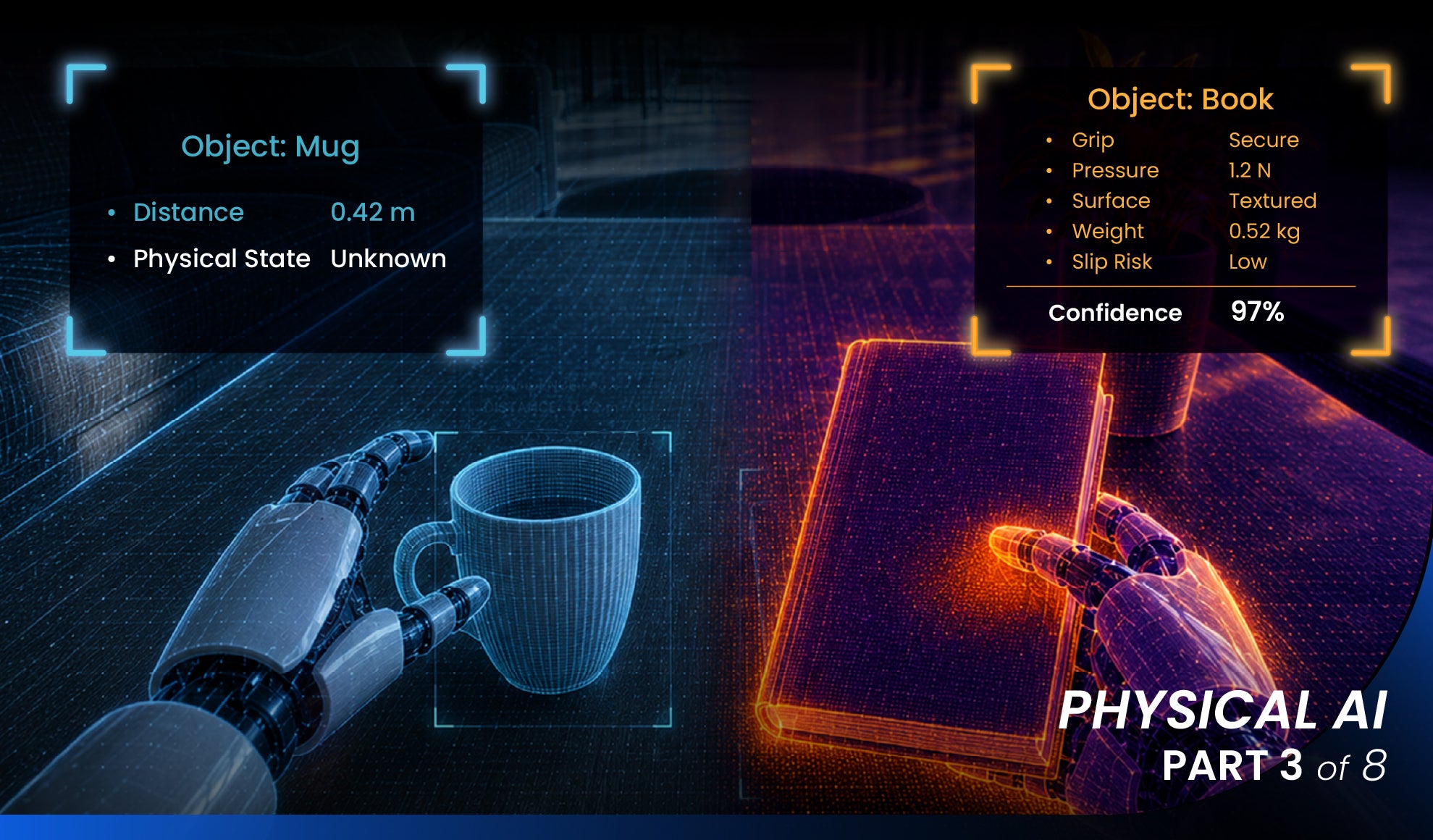
Take a self-driving car. It devotes much of its effort to understanding the world well enough to avoid contact; contact generally signals failure. Robotic dexterity reverses that priority. The entire point is to make deliberate contact: the robot has to grasp, hold, and manipulate an object while applying enough force to keep it secure without dropping or damaging it. Vision can tell a robot where an object is. It cannot tell the robot how that object pushes back the instant the fingers close around it. For that you need several modalities working together — tactile sensing, force measurement, slip detection, and deformation — feeding a continuous loop in which sensors measure grip and contact; the AI decides whether the grasp is secure, fragile, or beginning to fail; the actuators adjust, and the sensors immediately measure again.
There's also a less glamorous requirement: keeping sensor performance stable in the physical world. Materials age. Sensor characteristics drift. Temperatures swing, moisture intrudes, mechanical parts wear. A tactile system that's accurate on day one and unreliable on day five hundred isn't a product. Staying trustworthy while your own hardware changes underneath you demands continuous calibration, compensation algorithms, and a deep, earned understanding of materials. That discipline — robustness to drift, fatigue, and aging — is exactly the muscle built by shipping billions of sensors into phones, cars, and laptops that simply had to keep working, for years, in the real world.
For a robot to respond with human-like dexterity, the whole chain, from sensing to inference to motion, has to run at very low latency and with very high reliability. Input, intelligence, and output can no longer be separate boxes bolted together; they must behave as one system.
The forecast, in hindsight: What the name Synaptics predicted
Synaptics, the company named after the connections between neurons and founded to build the brain in silicon, spent four decades quietly refining the senses — touch, sound, sight — at the Edge, interpreting imperfect signals in real time. Now the robotics industry needs precisely that: a reliable sense of touch for machines that have to reach into the physical world and act.
The name was never marketing. In hindsight, it reads like a forecast.
The nervous system for Physical AI, it turns out, has been a long time coming.
Next in the series: Two Billion Fingertips — what shipping touch sensing at planetary scale actually taught us about pulling a trustworthy signal out of a noisy world.