
At COMPUTEX this year, we’re showcasing something that reflects a broader shift happening across the industry: intelligence is moving closer to where work actually happens—at the Edge.
For years, docking stations have played a simple but important role—connecting devices, expanding displays, and enabling productivity. But fundamentally, they’ve remained passive infrastructure. That’s starting to change.
At Synaptics, we’ve been asking a different question: what if the dock itself became intelligent?
From Connectivity Hub to Compute Platform
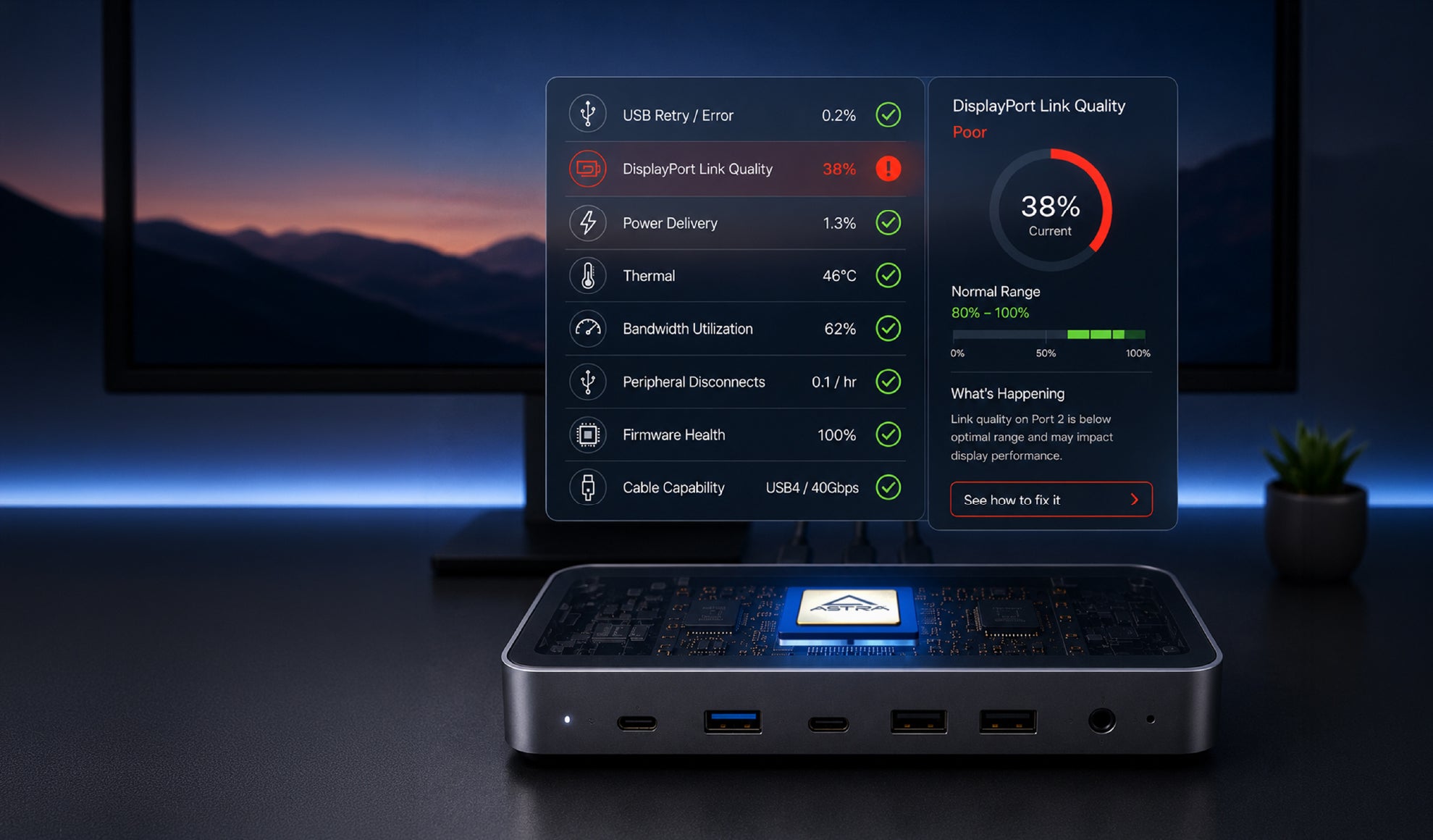
Powered by our Astra™ AI-native platform and built on our DisplayLink DL-7000 Series chipset family, we’ve developed an AI-enabled dock that goes beyond connectivity. It brings local compute, AI inference, and system awareness directly into the docking experience. The result is an Edge AI-enabled docking station that combines local compute, on-device AI inference, and intelligent diagnostics in a single enterprise-ready form factor.
This isn’t about incremental improvement—it’s about redefining what a dock can be.
Built-In Diagnostics That Actually Help
One of the most immediate benefits of embedding intelligence into the dock is visibility.
Traditional setups often leave IT teams blind to what’s happening at the edge—whether it’s display issues, peripheral failures, or intermittent connectivity problems. By integrating on-device diagnostics, the dock can continuously monitor its environment and provide actionable insights.
Instead of reactive troubleshooting, we move toward predictive maintenance and faster issue resolution. That’s a meaningful shift for enterprise IT efficiency.
Enabling Local AI with Small Language Models
Another key capability is support for small language models (SLMs) running locally on Astra.
This opens the door to entirely new interaction models. Imagine a user or IT admin being able to query the dock directly—asking for status, troubleshooting guidance, or configuration help—in natural language, without needing cloud access.
Running these models locally is important. It reduces latency, improves privacy, and ensures functionality even in constrained or offline environments. This is where Edge AI becomes practical, not just conceptual.
Host-Less Thin Client: A New Deployment Model
Perhaps the most transformative aspect is the ability to operate without a traditional host device.
With integrated compute and networking, the dock can function as a thin client—connecting users directly to virtual desktops or cloud environments. In other words, the dock itself becomes the endpoint.
This has significant implications:
- Simplified hardware deployments
- Lower endpoint costs
- Improved security through centralized compute
- Greater flexibility in shared or managed workspaces
It’s a fundamentally different way to think about end-user computing.
Seamless Multi-Display, Powered by DisplayLink
Of course, none of this comes at the expense of performance. Leveraging DisplayLink’s DL-7000 Series chipset, the dock continues to deliver high-quality multi-display support with efficient bandwidth usage and low latency.
The goal is simple: add intelligence without compromising the core experience users expect.
See It Live at COMPUTEX
We’ll be demonstrating this AI-enabled dock live at COMPUTEX, showing real-world scenarios—from autonomous diagnostics to conversational interfaces and host-less thin-client operation.
More importantly, we’ll be sharing a perspective on where edge AI is headed. The devices we interact with every day—docks included—are becoming active participants in the computing experience.
And this is just the beginning.
Experience it live at COMPUTEX Taipei, Nangang Exhibition Center Hall 2, Suite #X0022 — or explore the Astra AI-native platform at https://synaptics.com/products/embedded-processors.