
Part 1 ended with an image: catching a slipping glass before you've consciously registered that it's moving. Hold that thought literally.
Picture a condensation-slicked glass of water in your hand, eyes closed. As it begins to slide, you don't need to see it to react. Your fingertips pick up a faint change in vibration and pressure, and your brain issues a "smart squeeze" — just enough extra force to arrest the slide without shattering the glass. The whole loop, from sensation to correction, runs below the level of conscious thought.
That loop is one of the hardest things to reproduce in a robot. Machines can compute precise trajectories and lift enormous loads, yet they remain clumsy about the feel of friction. The traditional answer was pre-programmed rigidity: apply a fixed grip force and hope the object — steel or sponge — cooperates. To get past that, researchers have gone looking for something more subtle: the moment, invisible to the eye, when a stable hold begins
Slip is a spectrum, not a switch
The first useful reframing is that slip isn't a binary event. It isn't "held" and then suddenly "dropped." It's a progression — and to see why, you have to zoom into the contact patch, the tiny region where skin actually meets the object.
At a microscopic level there is no such thing as a smooth surface. Even polished glass is a landscape of jagged peaks and valleys, and true contact happens only at the highest peaks — what tribologists call asperities. Press a compliant fingertip onto a surface and those asperities catch against each other, but the pressure isn't uniform: it's highest at the center of the contact patch and tapers to nothing at the edges. So when a tangential load builds — gravity tugging a glass downward, the arm accelerating sideways — the asperities at the periphery reach their limit and break free first, while the center is still locked solid. The contact patch is simultaneously slipping at its outer ring and sticking at its core.
This is incipient slip: the early stage of failure, when part of the contact patch is already starting to slide while the rest still holds. The object has not visibly moved yet, but the grip is no longer fully stable. That is what makes incipient slip so important: it gives a robot a chance to respond before a secure grasp becomes a dropped object.
The same idea can be described through the friction cone. The harder a fingertip presses, and the higher the friction between the fingertip and the object, the more sideways force the grip can tolerate. But once that sideways force exceeds the grip’s friction limit, partial slip turns into full sliding. At that point, the robot is no longer preventing failure; it is reacting to it.
That shift in question — from "did the object fall?" to "is the contact interface beginning to fail?" — is the whole game. The first question can only ever trigger an apology. The second enables a reaction. to come apart.
The biological blueprint: a reflex, not a thought
Nature has already solved this through the human hand, and studying how is instructive. In foundational micro-neurography work in the 1980s, researchers Johansson and Westling recorded from single nerve fibers in human fingertips while people gripped and lifted objects. They found that humans correct grip force roughly 74 milliseconds after slip begins — an automatic sensorimotor response that occurs before conscious deliberation. Crucially, the receptors that fire are the fast-adapting ones: nerve endings that ignore steady pressure and respond only to dynamic, high-frequency vibration. They are, in effect, biological accelerometers, tuned to hear the high-frequency chatter of asperities snapping free at the contact edge.
That 74-millisecond figure is a useful benchmark for robotics — and it tells you something about the sensing required. Detecting the onset of slip requires catching fast vibration, while understanding and controlling the grasp also requires a dense spatial map of pressure and shear.
The two-rate insight: hearing friction while feeling pressure
Here's the deeper pattern, and it keeps reappearing across independent research groups, biology and silicon.
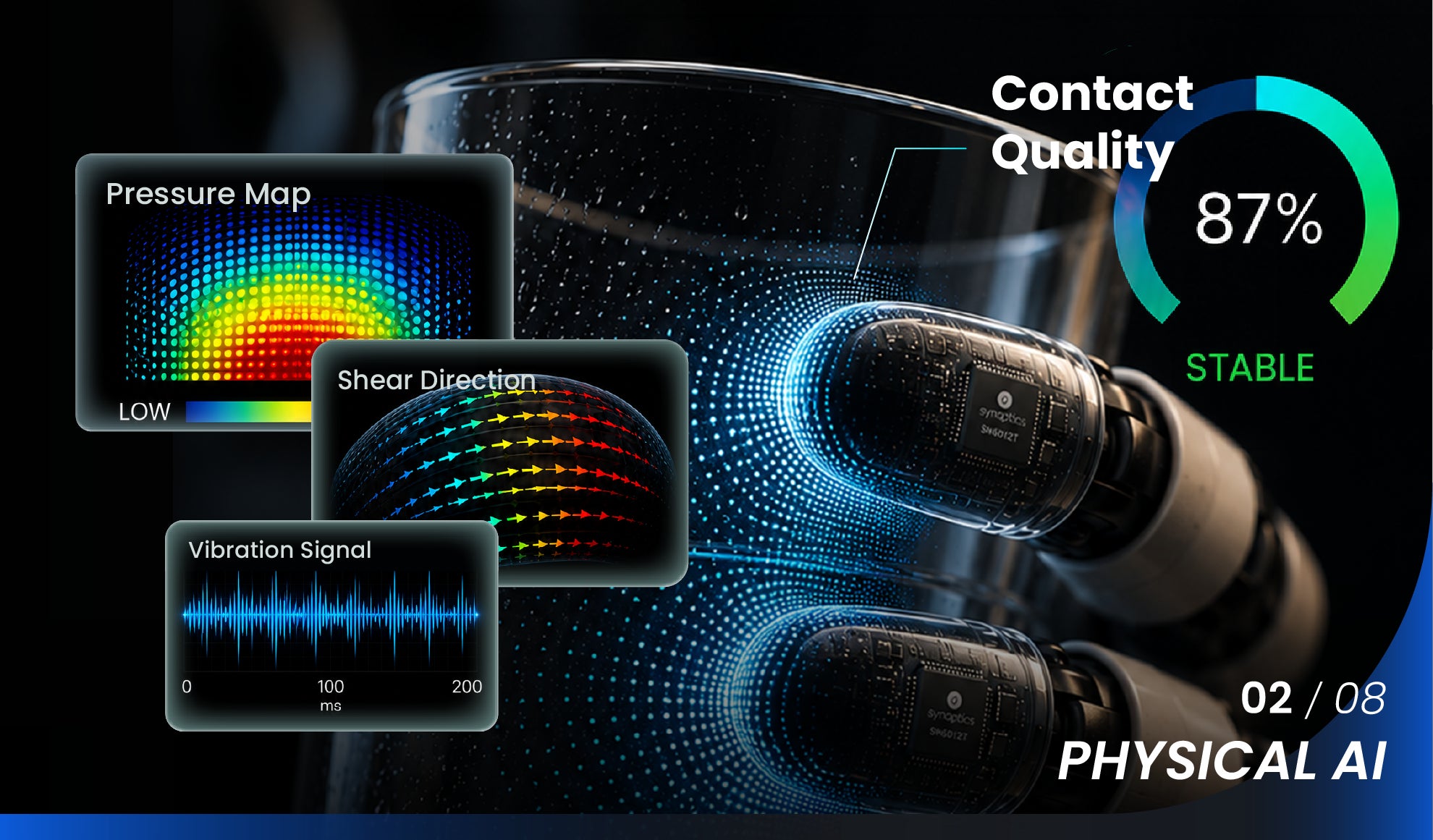
No single measurement captures slip. Catching the onset of failure is a fast, transient phenomenon — the high-frequency shudder of one surface beginning to break free of another, with spectral energy concentrated in the tens-to-hundreds-of-hertz range. Understanding the state of the grasp — where the load sits, how pressure is distributed across the fingertip, and how close the contact is to the edge of its friction cone — is a spatial task, one for which dense capacitive sensing is particularly valuable. The two channels operate at different timescales and provide complementary information: one captures rapid changes, while the other provides detailed context across the contact patch.
So the field has converged on a two-channel, two-rate architecture that mirrors the layered design of human skin:
- A fast channel — a dynamic transducer such as a piezoelectric (PVDF) film or a small accelerometer, sampled at very high rates, often in the kilohertz — that captures micro-vibrations. This is the sound of friction: the acoustic signature of a surface starting to slide, the engineered analog of those fast-adapting nerve endings.
- A spatial channel — such as a dense capacitive pressure-and-shear-mapping array — that captures the quasi-static shape of the contact: where the centroids of force sit, how the load is distributed, and whether the center of pressure is migrating toward the failing edge.
One channel hears the slip beginning; the other feels exactly where and how hard the fingertip is loaded, and how close it is to the friction limit. Fuse them and you get a more complete spatial-and-temporal picture of a contact event — something neither channel could provide on its own. This two-rate pattern isn't a quirk of one lab; it is the natural answer to a physical problem, and it's a principle worth holding onto for the rest of this series.
It also explains a subtle, important constraint. The fast channel has to be fast enough. Slip vibrations can run to several hundred hertz, and a basic principle of signal processing — the Nyquist limit — says you must sample at more than twice the highest frequency you care about, or the vibration doesn't just get missed, it gets corrupted into false low-frequency signals. That’s why the dynamic channel is sampled in the kilohertz. A spatial channel alone cannot preserve that high-frequency transient, just as a fast channel alone cannot explain how forces are distributed across the contact patch.
Why "how fast is it moving?" is the wrong question
For years a common approach to slip detection was velocity-based: measure how fast the tactile surface is sliding. It's intuitive, and it works — until the robot meets an object it has never seen before.
In reported tests, velocity-based detection struggled on soft and irregular items, with accuracy dropping into the low forties on a sponge and a computer mouse. The reason is mechanical: soft objects make the sensor skin deform so much that the system mistakes its own squish for the object sliding. The signal drowns in noise.
A more robust idea borrows the language of thermodynamics. In optical tactile sensors — a soft gel skin studded with markers, watched from behind by a tiny camera — a stable grasp shows the markers displaced but orderly; their displacement field is low in entropy. As the grip begins to fail, that order collapses into disorder, and the disorder spikes first at the edges of the contact patch, exactly where the slip annulus forms. By quantifying that statistical messiness, a system can sense the early signs of a failing grip without any prior model of the object.
There's a catch, though: an oddly shaped object can produce high baseline entropy even when the grip is rock-solid. A lumpy surface looks "disordered" just sitting there. The fix is to stop watching the disorder itself and start watching how fast it's changing — the derivative of entropy. Tracking the rate of change lets a system ignore the static noise of a complicated shape and lock onto the one thing that signals failure: the moment disorder begins to climb. One such method reported slip detection above 95% accuracy across a range of objects with no prior knowledge of any of them. It's the derivative, not the value, that betrays the ghost — and because disorder is a universal property of a failing grip, the approach is less dependent on prior knowledge of the object. A method that only works on objects you've already trained on isn't dexterity; it's memorization.
The "smart squeeze": reacting without dropping or crushing
Detecting the ghost is only half the job. The reaction has to be precise, because the obvious response — just clamp down harder — can crush a fragile object, knock it out of position, or simply waste force. Humans hold things at the minimum force needed, plus a slim safety margin, which is exactly why we can pick up a raspberry without pulping it.
Advanced control frameworks take a more surgical approach with multi-fingered grippers, redistributing internal forces in the "null space" of the grasp — changing how the fingers press against an object without changing the net force on the object itself. The object stays put, but the grip becomes more secure. Three moves do the work:
- Widen the friction cone — push a little more firmly along the surface normal to expand the margin before sliding.
- Cut the gliding forces — reduce the tangential components actively driving the slide.
- Balance the load — spread weight across the fingers so no single contact is overwhelmed.
Done well, this kind of reactive control has been demonstrated arresting slip on objects the system had never encountered, adjusting grip in real time with no prior model — and matching that ~74-millisecond human reflex benchmark. Just feel, and respond.
From physics to silicon
All of this — the two-rate sensing, the focus on rate-of-change, the need to work with unfamiliar objects — describes a research frontier. It also describes both a learning problem and a hardware challenge, and that combination is the part we find most exciting.
Humans do not simply react to slip; they learn from it. Through repeated interactions, the nervous system builds expectations about how different surfaces, weights, and contact conditions will behave. That experience becomes sensorimotor memory — what we commonly call muscle memory — allowing us to anticipate the grip force an object will require and adapt more quickly when conditions change. Physical AI will need a similar learning loop, in which materials, sensing hardware, signal processing, and AI models work together to improve grasping performance over time.
A robotic fingertip that works in the real world has to do three things at once. It has to run a fast dynamic channel and a dense spatial channel together and fuse their signals. It has to turn those raw signals into a decision — is this slipping? — that can drive an immediate local response. An Edge AI processor within the hand can handle this localized tactile processing close to the sensors and actuators, closing the sense-decide-act loop in milliseconds rather than waiting on a round trip to a central processor. The central processor can then remain focused on higher-level planning and coordination. And it has to keep doing all of this as the hardware ages: as elastomer skin wears, as temperature drifts, as electrical noise crowds in.
Maintaining dependable sensing as the hardware and operating conditions change may be the hardest requirement of all. An entropy-style method is only robust to unfamiliar objects if the sensor underneath it is robust to unfamiliar conditions — if it can hold a stable baseline while the world around it shifts. Extracting a trustworthy signal of real contact from a noisy, drifting, aging system, at high speed, on billions of events, is not a new problem to us. It's the same discipline that decides whether a touch on a phone screen is a finger or a water droplet — moved onto the fingertips of a machine. More on that in the posts ahead.
For now, the takeaway is simple. The future of dexterous robots won't be won by gripping harder. It'll be won by feeling earlier, learning from experience, and responding close to the point of contact — catching the ghost in the grip before it becomes a sound on the floor.
Next in the series: Named After Neurons — how a company founded by pioneers of the touchpad and neural computing came to build the nervous system for robots.