
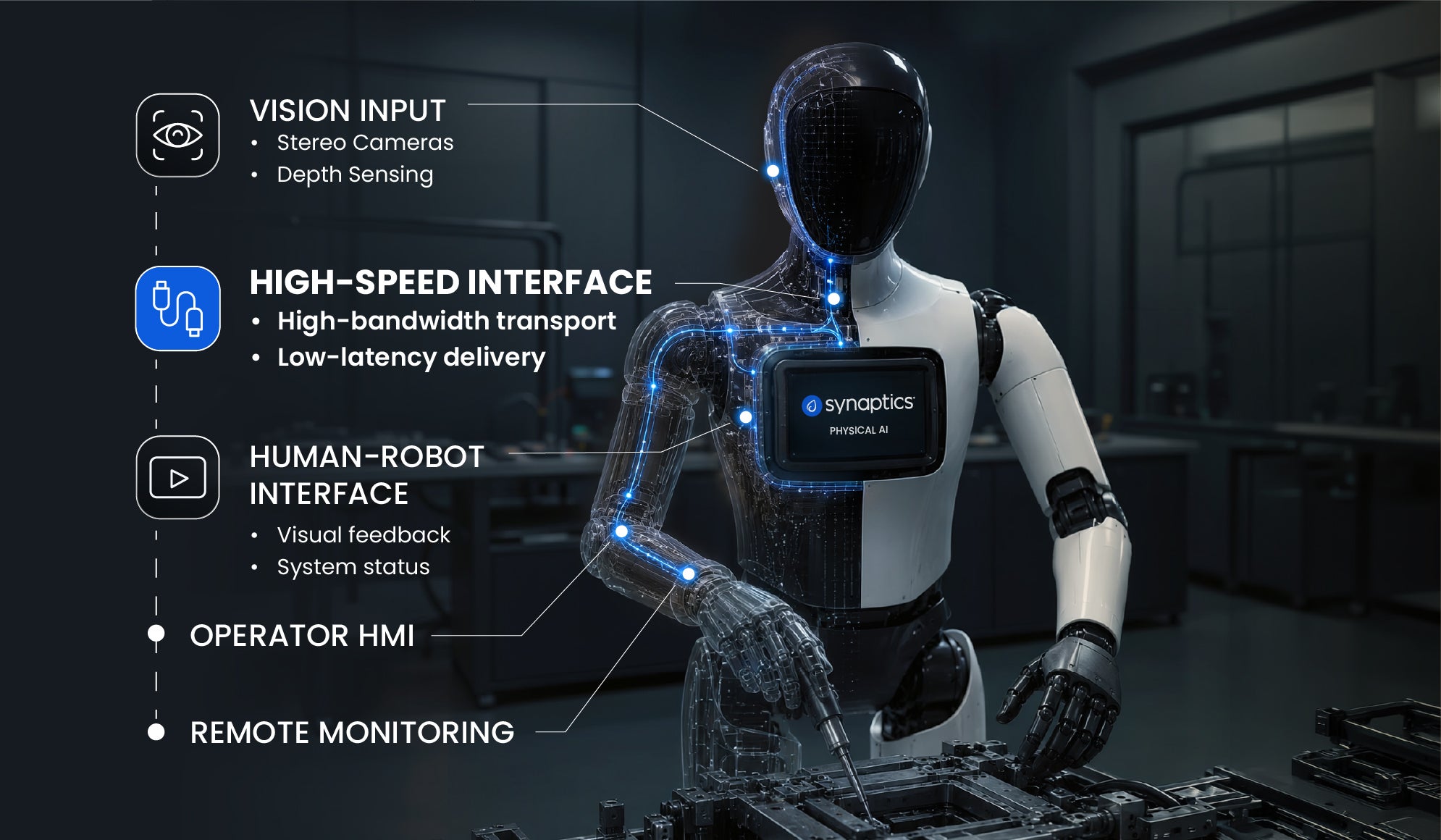
Artificial intelligence is ushering in the era of Physical AI—systems that not only understand and generate information but also perceive, reason, and act in the physical world. This shift is fueling a new wave of innovation in robotics, from humanoid assistants and autonomous mobile robots to collaborative industrial systems and advanced surgical platforms.
As these systems become more autonomous, they are also becoming more visual. Cameras and sensors help robots perceive their surroundings. Displays, human-machine interfaces, operator consoles, and remote monitoring systems help people understand what a robot is doing, decide when to trust it, and know when to intervene or collaborate. While the industry has primarily focused on AI computing and sensing, another crucial aspect of robotics often goes unnoticed: the efficient transportation of high-resolution video and display data within increasingly complex robotic systems. Cameras, AI accelerators, embedded displays, operator consoles, and remote monitoring systems must exchange vast amounts of visual information with minimal latency. Moving that information efficiently, reliably, and securely is becoming one of the defining architectural challenges of modern robotics. In robotics, high-speed interfaces are the technologies that move high-bandwidth video and display data between AI processors, cameras, embedded displays, operator systems, and remote endpoints.
At Synaptics, we see this as a natural extension of our work in display connectivity: as robots become more intelligent, the interface layer that connects perception, compute, and human interaction becomes strategic.
Visual Communication Is Becoming the Human-Robot Interface
AI enables robots to interpret context and make decisions. Visual interfaces communicate those decisions to people.
Whether it is a humanoid robot interacting naturally with people, a service robot assisting customers, an industrial robot providing operational feedback, or a surgical robot supporting life-saving procedures, visual information is central to how humans understand and trust intelligent machines.
Displays today are no longer simple status panels. They have become the primary interface between humans and increasingly autonomous systems. They present navigation information, operational status, diagnostics, remote video feeds, and immersive visualization. In humanoid robots, they can also provide personality and emotional expression, making interactions more intuitive and engaging.
As robots become more autonomous, visual communication becomes part of the user experience, not an afterthought. The display architecture behind that experience matters.
Robotics Is Redefining System Architecture
In consumer electronics, the processor is often placed next to the display. Modern robotic systems are different. AI compute platforms are commonly located in the torso or base, while displays may be distributed across the head, torso, arms, operator console, or remote workstation. These displays may be separated by several feet of cabling routed through rotating joints, flexible neck assemblies, articulated arms, or other constrained mechanical paths.
That creates a very different set of design tradeoffs. Robotics developers must route visual data to these displays while balancing several key care-abouts:
- Mechanical complexity
- Cable weight
- Power consumption
- Signal integrity
- Thermal performance
- Electromagnetic compatibility
- Reliability
- Manufacturing cost
Every additional cable increases weight. Every connector introduces another potential failure point. Every watt affects battery life and thermal design. The challenge has shifted from simply connecting a display to architecting an efficient communication network for visual data inside the robot.
What High-Speed Interfaces Do in Robotic Systems
At the “heart” of every robotic system is an AI compute platform. Around it is a distributed set of endpoints: cameras and sensors, head displays, operator HMIs, service panels, peripheral displays, and remote teleoperation systems. High-speed interfaces connect these blocks and move visual data to the points where humans and machines interact.
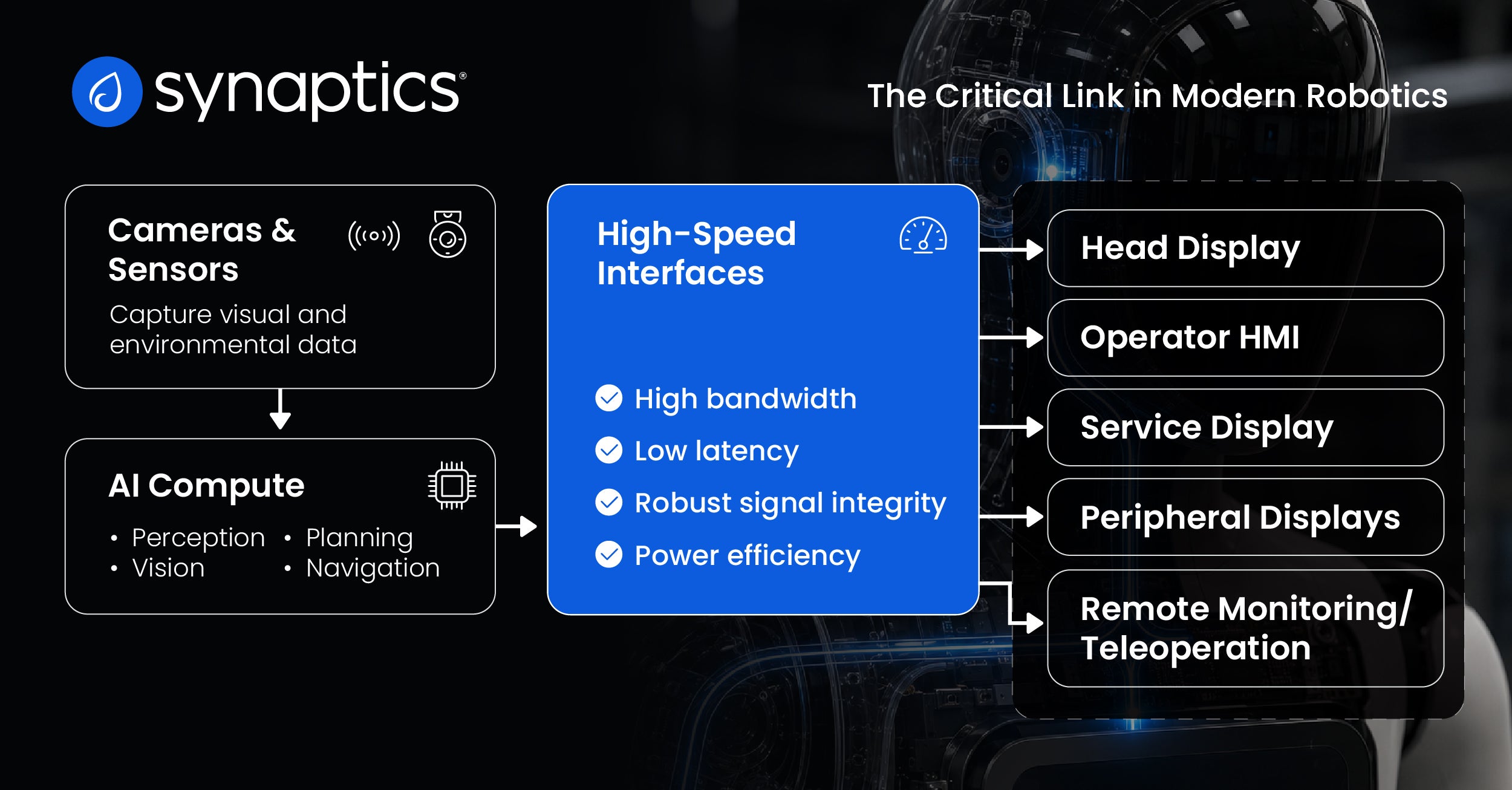
Figure 1. High-speed interfaces connect AI compute platforms to every point of human interaction, transporting video and display data throughout the robotic system.
These interfaces do far more than move pixels. They reduce wiring complexity, preserve signal integrity, minimize latency, improve power efficiency, and provide the architectural flexibility needed for next-generation robotic platforms.
Why Robotics Requires Flexible Display Interfaces
Since robotics and Physical AI systems are still in their infancy, system architectures are continually evolving and exhibiting a wide range of designs. Some AI processors include built-in GPU capabilities and native DisplayPort outputs capable of driving multiple high-resolution displays directly. Others prioritize AI acceleration and offer limited display capabilities, making USB- or Ethernet-based video transport an efficient alternative.
Some systems require protocol conversion between DisplayPort, MIPI, LVDS, USB, or automotive video interfaces to support specialized embedded displays.
Rather than forcing designers into a single architecture, modern robotics demands interface flexibility. The ability to transport high-quality video regardless of processor choice or display technology allows engineers to optimize the entire system rather than designing around interface limitations.
From Architecture to Deployment
These architectural challenges are no longer theoretical. Across the robotics industry, we're seeing similar design patterns emerge as developers balance AI performance, mechanical constraints, and user experience.
One leading humanoid robotics customer faced a common challenge: its AI compute platform delivered exceptional inference performance but offered limited native display capability for a head-mounted display. Rather than redesigning the compute subsystem, the engineering team adopted a Synaptics DisplayLink® USB-based video transport architecture that moved high- quality, low-latency video from the torso to the head over a lightweight cable. The approach reduced wiring, simplified the mechanical design, and helped maintain excellent signal integrity across a moving system.
In another customer's humanoid design, the system needed to support multiple high-resolution displays while routing video through a narrow neck assembly. By combining Synaptics’ long-reach video transport with protocol bridges to embedded display interfaces, the architecture reduced cable complexity, maintained reliable signal quality over several feet, lowered power consumption through efficient display management, and created a scalable foundational architecture for future product generations.
The same architectural principles extend well beyond humanoid robots. A robotic medical platform required multiple synchronized 4K displays for precision visualization while maintaining extremely low latency and uncompromised image quality across extended cable lengths. A Synaptics high-bandwidth DisplayPort-based architecture enabled multiple uncompressed display streams while delivering the reliability, security, and deterministic performance required for mission-critical medical environments.
Different markets, same underlying requirement: move video and display data from AI compute engines to the points where humans interact with the robot.
Why Cable Reduction Improves Robotic System Design
Anyone who has peered inside a modern humanoid robot soon discovers there is little unused space. Every cable must travel through narrow joints, articulated necks, rotating shoulders, or moving arms. Cable bundles increase weight, reduce flexibility, complicate manufacturing, and affect long-term reliability. Reducing wiring is not simply a cost decision.
It directly improves:
- Freedom of movement
- Mechanical simplicity
- Manufacturability
- Serviceability
- Battery efficiency
- Long-term reliability
Bandwidth is often the first specification engineers consider when evaluating interface technologies. But robotics demands much more. Latency affects how natural an interaction feels. Signal integrity determines whether systems continue operating reliably through constant motion. Power efficiency affects battery life and thermal design. Security protects mission-critical visual information. Scalability allows the same architecture to support multiple products across a robotics portfolio. The most successful robotic systems will be optimized across all of these characteristics.
The Synaptics Perspective
Robotics developers face a wide range of system architectures, and no single interface technology fits every design. Some AI SoCs provide native DisplayPort outputs capable of driving multiple high-resolution displays, while others prioritize AI acceleration and offer limited native display connectivity. Some robots require embedded displays located several feet from the compute engine, while others must support multiple operator consoles or external monitors.
This diversity is exactly where Synaptics' High-Speed Interface portfolio provides value.
For systems where video must be transported from processors without native display outputs, DisplayLink decoders support USB- or Ethernet-based video delivery to embedded eDP, MIPI, or LVDS displays using fewer wires and simpler mechanical routing. This is especially relevant in compact humanoid and service robots, where cable count, flexibility, and weight directly affect the overall architecture.
Where AI processors provide native DisplayPort connectivity, Synaptics DisplayPort bridge ICs help convert DisplayPort to embedded display interfaces such as eDP, MIPI DSI, or LVDS. These bridges allow designers to connect a wider range of panels while preserving image quality, supporting long-reach video transport technologies, and reducing system complexity.
For systems that need multiple displays—for operator interfaces, diagnostics, navigation, or human interaction—DisplayPort MST hubs allow a single high-bandwidth DisplayPort connection to drive multiple independent displays. This can reduce processor I/O requirements, simplify system expansion, and provide scalability as robots become more visually interactive.
Together, these technologies give robotics developers a flexible toolkit for USB-based video transport, native DisplayPort connectivity, protocol conversion, multi-display expansion, and embedded panel integration. The goal is not to force a fixed architecture. It is to let designers choose the right interface strategy based on processor choice, mechanical constraints, display topology, and application requirements.
Looking Ahead
Over the next few years, AI will continue to transform robotics. Machines will become more autonomous, more collaborative, and more capable of operating safely alongside people. But the user experience will not be defined by intelligence alone. People will judge robots by how clearly they communicate, how naturally they respond, and how reliably they perform in real-world environments.
That communication will increasingly be visual, whether through expressive humanoid faces, immersive surgical displays, industrial HMIs, or remote teleoperation consoles.
As Physical AI matures, success will depend on more than AI accelerators. It will require complete system architectures that move information efficiently between perception, compute, and human interaction. High-speed interfaces may be largely invisible to users, but they will become foundational to how intelligent robots are designed, deployed, and trusted.
At Synaptics, we are applying decades of connectivity experience across enterprise, automotive, consumer, and embedded systems to help developers solve this challenge. High-speed interfaces are becoming a strategic layer of the robotics technology stack—and we are just getting started.